Artificial Intelligence
Why Text-to-SQL Models Break in Production (And How Semantic Layers Solve the Problem)
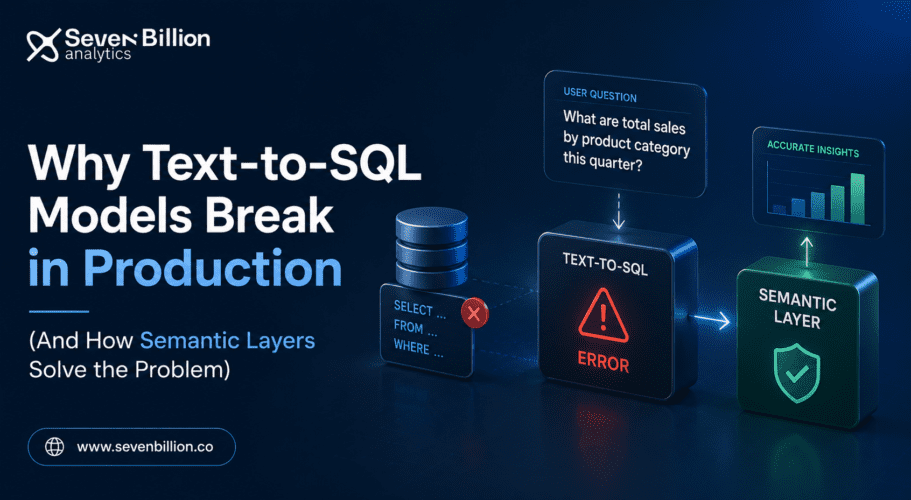
Many people in the data and AI industry believe that adding RAG automatically makes AI agents effective. However, in real enterprise environments, most AI agents that perform well in demos struggle once deployed at scale. They hallucinate responses, lose workflow context, misuse tools, and eventually function more like expensive autocomplete systems than intelligent business solutions.
One of the biggest reasons behind these failures is the heavy dependence on text-to-SQL generation. Over time, it has become clear that relying only on text-to-SQL is less effective than combining Large Language Models (LLMs) with a semantic layer.
If organizations want AI systems that can scale and reason accurately, it is important to understand why text-to-SQL models fail and how semantic architecture fixes these issues.
Table of Contents
The Main Problem with Text-to-SQL Models
To understand the limitations of text-to-SQL systems, it is important to understand how LLMs work. LLMs are prediction systems, not true reasoning systems. Their primary function is to predict the next likely token based on patterns, which does not automatically guarantee factual accuracy or logical business reasoning.
When an LLM is given a raw database schema and asked to generate SQL queries, it depends heavily on semantic similarity and probability-based predictions. Since the model does not actually understand organizational rules or domain-specific logic, it often produces hallucinated joins, incorrect metrics, and broken integrations.
Expecting an AI agent to fully understand raw database schemas is similar to asking someone to interpret a complex legal document in an unfamiliar language simply by showing them the characters. The context and meaning are missing.
The Shift Toward Semantic Layers and Ontologies
Organizations successfully deploying Enterprise AI agents are moving away from pure text-to-SQL approaches. Instead, they are using ontologies and knowledge graphs supported by semantic layers.
A semantic layer works as a translation framework between technical database structures and business language. Rather than treating data as disconnected text, an ontology creates a structured and machine-readable representation of operational reality. It defines entities, relationships, properties, and approved actions.
With this structure in place, AI agents move from probabilistic guessing to more deterministic execution. Instead of generating responses from loosely connected schema patterns, the system follows clearly defined semantic relationships that support accurate and explainable reasoning.
How to Build a Semantic Layer and Ontology
Building an ontology is an incremental process. Organizations do not need to model the entire enterprise immediately. Most successful implementations begin with smaller operational domains and expand gradually over time.
Below is a proven three-step approach for building an industrial ontology for AI systems.
Step 1: Build the Semantic Model
The first step is creating a shared business vocabulary across the organization.
This semantic model removes ambiguity by standardizing business terminology so that terms such as “equipment” or “customer” have the same meaning across departments like manufacturing, engineering, and finance.
The semantic vocabulary is typically built using:
Nouns
The primary business entities such as:
- Equipment
- Operator
- Work Order
Verbs
The relationships connecting those entities such as:
- Produces
- Operates
- Validates
Adjectives
The states describing those entities such as:
- Active
- Certified
- Pending
Step 2: Develop Domain-Specific Ontologies
Once the shared vocabulary is established, it is applied to individual operational domains such as production, quality, or maintenance.
At this stage, organizations define the appropriate level of detail along with the rules and constraints specific to that operational area.
A strong domain ontology is generally built around four structural components.
Object Types
These represent categories of physical or abstract entities such as:
- Machine
- Quality Inspection
Properties
These define identifiers or characteristics associated with those entities such as:
- Serial Number
- OEE Score
Link Types
These describe the semantic relationships between entities.
For example:
- Operator operates Machine
Action Types
These define the approved actions within the domain along with their required conditions and resulting state changes.
For example:
- Schedule Maintenance
Step 3: Populate the Knowledge Graph
The final step is connecting real operational data to the ontology structure.
The knowledge graph acts as the foundational semantic data layer that populates the ontology with actual business information.
At this stage, instead of understanding only the general concept of a “CNC Machine,” the AI system can identify specific operational entities such as “CNC Mill Station 7” operating a particular batch of materials.
This transforms the ontology from a conceptual structure into a real operational intelligence system.
The Importance of Knowledge Architecture
The biggest difference between a fragile text-to-SQL chatbot and a reliable enterprise AI agent is not the size of the LLM. The real difference is the knowledge architecture supporting it.
Organizations looking for scalable and dependable AI systems must move beyond basic prompt engineering. By investing in semantic models, domain ontologies, and populated knowledge graphs, businesses provide the structured context AI systems need to stop relying on probabilistic guessing and begin operating with more deterministic reasoning at enterprise scale.



-

 Business5 years ago
How to Do Long-Distance Moves with Children
-
 Business3 years ago
The Ultimate Guide To Thriving In Your Printing Franchise
-
Business3 years ago
Exploring The Benefits And Challenges Of Restaurant Franchising
-

 Tech5 years ago
Cyber Table That Will Change Your Life
-

 Biography4 years ago
Melody Marks- Personal Life, Education, Career, And Much More
-
Lifestyle3 years ago
Dallas’ Hidden Gems: 6 Must-Try Restaurants Off The Beaten Path!
-

 Business6 years ago
Is Guest Posting a Good Inbound Marketing Strategy?
-
Lifestyle3 years ago
Top 10 Restaurant Franchises In The US






Recent Comments